Granada
Updated October 16, 2026
Also known as: Garnata, Gharnata
Main Landmarks in Granada

Albaicín and Mirador de San Nicolás
The Albaicín is the old Moorish quarter on the hill facing the Alhambra, a UNESCO World Heritage Site since 1994. Its steep cobbled lanes, whitewashed carmenes and hidden squares preserve the street plan of the medieval city. The Mirador de San Nicolás offers the classic sunset view of the Alhambra against the Sierra Nevada, and it gets very crowded. For a quieter view, walk to the Mirador de San Cristóbal or the Mirador de la Vereda de Enmedio. Take bus C31 or C32 to save your legs.

Royal Chapel and Granada Cathedral
The Capilla Real, finished in 1517, holds the tombs of the Catholic Monarchs Isabella and Ferdinand, together with their daughter Joanna the Mad and her husband Philip the Handsome. Their simple lead coffins rest in a crypt below elaborate marble tombs. Next door, Granada Cathedral, begun in 1523 on the site of the main mosque, has a dazzling white Renaissance interior by Diego de Siloé. Each costs around €6–7. The nearby Alcaicería, a rebuilt silk market, sells lamps, spices and ceramics.

Alhambra and the Nasrid Palaces
The Alhambra is a fortified palace city built mainly by the Nasrid dynasty in the 13th and 14th centuries and the most visited monument in Spain after the Sagrada Família. The Nasrid Palaces, with the Comares Hall, the Court of the Myrtles and the Court of the Lions, are its highlight. Daily visitor numbers are capped, and general tickets cost around €20 and must be booked weeks ahead. Your Nasrid Palaces entry time is strict, so arrive at the gate 15 minutes early with your passport.

Generalife
The Generalife was the summer palace of the Nasrid sultans, set on the slope above the Alhambra and surrounded by terraced gardens, orchards and water channels. Its Patio de la Acequia, a long pool lined with fountains and flowers, is one of the oldest surviving Moorish gardens in the world. The Generalife is included in the general Alhambra ticket, and a cheaper gardens-only ticket also exists. Visit in May for the roses, or on a summer evening when concerts are held in its open-air theatre.

Sacromonte
The Sacromonte is the hillside district of cave houses where Granada's Roma community developed zambra flamenco. In the evening, cave venues such as those on the Camino del Sacromonte host shows for about €25–35, often including a drink. The Sacromonte Caves Museum explains cave life, local crafts and the area's flora, with entry for around €5. Walk up at sunset for views of the Alhambra from the opposite side of the Darro valley. The Abbey of Sacromonte, at the top, holds catacombs.

Carrera del Darro and Paseo de los Tristes
The Carrera del Darro follows the small Darro river beneath the walls of the Alhambra and is often called one of the most beautiful streets in Spain. Stone bridges, Renaissance mansions and the 11th-century Arab baths of El Bañuelo line the route, with entry to the baths included in a combined monuments ticket. It ends at the Paseo de los Tristes, a riverside promenade with terraces facing the floodlit Alhambra at night. Walk it in the early morning or after dark for the best atmosphere.
History
Granada was the last Muslim kingdom in Western Europe, and its fall in 1492 closed nearly 800 years of Al-Andalus. Iberians and Romans settled the hill of the Albaicín first, and the Romans called the town Iliberis. Under the Zirid dynasty in the 11th century the town became the capital of an independent kingdom, and a large Jewish community lived in the quarter later called the Realejo. In 1238 Muhammad I founded the Nasrid dynasty, and over the next 250 years his successors built the Alhambra, the most refined palace complex of medieval Islam. Yusuf I and Muhammad V added the Comares Palace and the Court of the Lions in the 14th century. On 2 January 1492, Muhammad XII, known in Spain as Boabdil, handed the keys of the city to Isabella and Ferdinand, the Catholic Monarchs. Legend says he wept as he looked back from a mountain pass now called the Moor's Last Sigh. The monarchs chose Granada for their burial, and Charles V built a Renaissance palace inside the Alhambra in 1527. In the 19th century writers such as Washington Irving rediscovered the ruined palaces, and in 1984 the Alhambra and the Generalife became a UNESCO World Heritage Site, followed by the Albaicín in 1994.
Culture
Granada is a university city where around 60,000 students, many from abroad on Erasmus exchanges, keep the bars busy every night. Its most famous custom is the free tapa: in most bars, each drink comes with a plate of food chosen by the kitchen, and the portions grow with each round. Daily life moves between the Moorish hill of the Albaicín, the Christian centre around the Cathedral and the student districts of the Realejo and Plaza de Toros. The Sacromonte caves are the birthplace of zambra, a local style of flamenco performed by Roma families since the 16th century. Many residents of the Albaicín still live in carmenes, traditional walled houses with gardens and views of the Alhambra. The poet Federico García Lorca, born nearby in 1898, is the city's cultural hero, and his summer house is a museum. Teahouses, called teterías, on Calle Calderería Nueva serve mint tea and Moroccan pastries, a reminder of the city's long links to North Africa.
Climate
Spring
7–25°C
March to May is Granada's best season, with 15–25°C days, roses in the Generalife gardens and snow still visible on the …
Summer
17–35°C
June to August is hot and dry, with 32–36°C afternoons, though nights cool to around 18°C thanks to the altitude. Visit …
Autumn
6–26°C
September to November brings warm days of 20–28°C in September, cooling to around 15°C by November, and the first snow o…
Winter
1–14°C
December to February is cold and clear, with 12–15°C afternoons and frequent frosts at night near 0°C. The Sierra Nevada…
Fun Facts
Granada still gives away free tapas
Granada is one of the last cities in Spain where nearly every bar serves a free tapa with each drink. A caña of beer for…
Granada means pomegranate
The pomegranate, granada in Spanish, is the city's symbol and appears on bollards, manhole covers and the Spanish nation…
The Lions fountain works like a water clock
The Fountain of the Lions in the Alhambra has 12 white marble lions supporting a basin decorated with a poem by Ibn Zamr…
You can ski and swim on the same day
Granada sits 33 km from the Sierra Nevada ski resort, whose slopes reach above 3,300 m and are the southernmost major sk…
Washington Irving lived in the Alhambra
In 1829 the American writer Washington Irving stayed in empty rooms of the Alhambra, which was then semi-abandoned and i…
Granada has houses built into caves
In the Sacromonte and parts of the Albaicín, families have lived in whitewashed caves dug into the hillside since at lea…
Local Cuisine in Granada
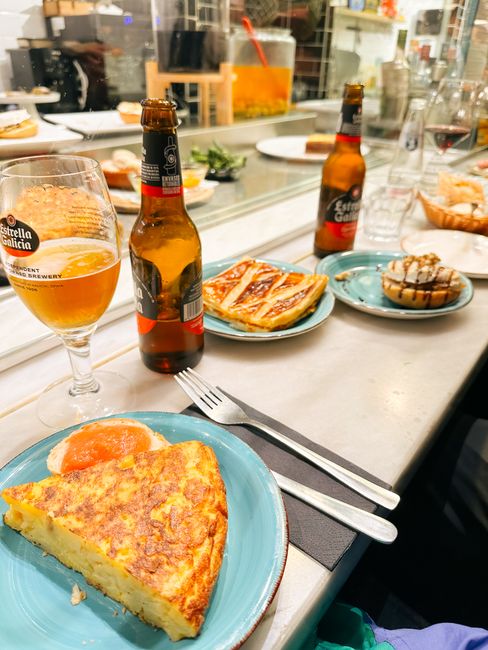
Free tapas
Every drink in Granada's bars comes with a free tapa, from fried aubergine with cane honey to small portions of stew, migas or grilled pork. The choice depends on the bar and the round. Calle Navas, the Realejo and the streets around Plaza Nueva are full of tapas bars where a caña with a tapa costs €2.50–3.50.

Tortilla del Sacromonte
An unusual omelette made with lamb brains and sweetbreads, sometimes with peas and ham, created by the Capuchin friars of the Sacromonte. It is rich, soft and an acquired taste. Traditional restaurants in the Albaicín and Sacromonte still serve it as a plate for €8–12, and many locals order it on special occasions.

Habas con jamón
Tender broad beans sautéed with Trevélez ham, cured in the Alpujarra mountains above Granada at more than 1,400 m altitude. Trevélez ham is prized for its sweet, delicate taste. The dish is best in spring, when the beans are young, and costs about €8–12 as a ración in traditional taverns.

Plato alpujarreño
A hearty mountain plate from the Alpujarra villages south of Granada, with fried potatoes, peppers, fried egg, morcilla, chorizo, pork loin and Trevélez ham. It was created to fuel farmers working on steep terraces. Today restaurants in Pampaneira, Bubión and Capileira serve it for €10–14, enough for two light eaters.

Piononos
Small cylinders of light sponge cake soaked in syrup and topped with toasted cream, invented in 1897 in the town of Santa Fe, 12 km from Granada, by baker Ceferino Isla. They were named in honour of Pope Pius IX. The original Casa Ysla bakery still sells them, and a box of six costs about €8.

Moroccan tea and pastries
Sweet mint tea served in silver teapots, with honey-soaked chebakia and almond pastries, is part of everyday life in the Albaicín's teterías. Calle Calderería Nueva, known as Tea Street, has a dozen cosy teahouses with cushions and lanterns. A pot of tea costs €3–4, and the pastries about €2 each.
Practical Travel Information
Transport & Accessibility
International Transport
Most international visitors fly into Málaga Airport, about 130 km southwest, which has direct flights from across Europe and some long-haul routes. Federico García Lorca Granada-Jaén Airport, 15 km west of the city, has domestic flights to Madrid, Barcelona and Palma, plus a few European routes. Since 2019 a high-speed rail line has connected Granada with Madrid in about 3 hours 20 minutes and Barcelona in about 6 hours. ALSA buses run frequently to Seville, Córdoba, Málaga and the Alpujarra villages from the main bus station on Avenida de Juan Pablo II.
Local Transport
Granada's centre is compact, but the Alhambra and Albaicín sit on steep hills. Small red minibuses, lines C30 to C35, run from Plaza Isabel la Católica up to the Alhambra, the Albaicín and the Sacromonte, with single tickets around €1.40. The Credibus card reduces fares. The Granada metro, a light rail line, links the north and south of the city but not the old town. Walking up to the Alhambra from Plaza Nueva via the Cuesta de Gomérez takes about 20 minutes. Driving in the historic centre is restricted, so leave cars in public car parks.
Safety & Health
Personal Safety
Granada is a safe, student-friendly city with low violent crime. Watch out for pickpockets near the Alhambra queues, in Plaza Nueva and at the Mirador de San Nicolás, where crowds gather at sunset. Some women near the Cathedral offer sprigs of rosemary and then demand money; politely decline. Late at night, the steep lanes of the Albaicín and the Sacromonte can be poorly lit, so walk in groups or use the minibuses. Keep a close eye on bags at outdoor terraces. In summer, the heat is the main risk, so carry water.
Medical Services
Hospital Universitario Virgen de las Nieves and the Hospital Clínico San Cecilio provide 24-hour emergency care. EU visitors can use the European Health Insurance Card in public hospitals; others should have travel insurance. Pharmacies are widely available, with night-duty pharmacies listed on every pharmacy door. The altitude of 680 m and dry air can be dehydrating, and summer days are hot, so drink plenty of water and wear sunscreen. Tap water is safe and comes from the Sierra Nevada. For emergencies, dial 112.
Budget & Costs
Travel Costs
Granada is one of the most affordable cities in Spain. A hostel bed costs €18–35, a mid-range hotel €70–130 and a boutique carmen hotel in the Albaicín €140–250. A drink with a free tapa costs €2.50–3.50, so a full tapas dinner can cost under €15. A menú del día costs €11–15, and dinner for two with wine €35–55. The Alhambra general ticket costs around €20, the Royal Chapel and the Cathedral around €6–7 each, and a Sacromonte flamenco show €25–35. A mid-range traveller can manage on €80–120 per day.
Budget Tips
Make dinner a tapas crawl, as two or three drinks with free tapas can replace a full meal. Buy the Granada Card if you plan to visit the Alhambra, the Cathedral, the Royal Chapel and use buses, as it bundles entries and transport. Many viewpoints, the Albaicín and the Alhambra woods are free. Walk instead of taking taxis, using the minibuses only for the steepest climbs. Visit between November and February, when hotels are at their cheapest. Avoid restaurants with set menus right in Plaza Nueva.
Culture & Traditions
Social Norms
Granadinos are known in Spain for their dry sense of humour and frankness, sometimes called mala follá, which visitors may mistake for rudeness. Greet with a simple hola or buenas, and a handshake or two kisses among friends. Do not expect a menu for the free tapa; accept what comes, and say thanks. Dress modestly in churches and the Royal Chapel. In the Albaicín, many carmenes are private homes, so respect privacy and noise levels at night. Tipping is optional, with small change or rounding up common.
Cultural Activities
Watch a zambra flamenco show in a Sacromonte cave, attend the International Festival of Music and Dance in June and July, or visit the Huerta de San Vicente, Federico García Lorca's summer house. Relax in the Hammam Al Ándalus, a modern Arab bath with hot and cold pools in the Albaicín. Join the Cruces de Mayo on 3 May, when squares fill with flower-covered crosses. On 2 January, the Día de la Toma commemorates the city's conquest in 1492 with a ceremony at the Town Hall.
Unique Experiences in Granada
Book a night visit to the Nasrid Palaces, when the courtyards and carved plaster walls are softly lit and visitor numbers are a fraction of the day crowds. Tickets cost around €10–12 and sell out weeks ahead in summer. Bring your passport.
Relax at the Hammam Al Ándalus near the Carrera del Darro, where you move between warm, hot and cold pools under arched ceilings and star-shaped skylights. A 90-minute session with a short massage costs about €50–70, and evening slots should be booked in advance.
Watch a zambra in a Sacromonte cave, a fiery flamenco style performed by Roma families since the 16th century, in a whitewashed cave where the dancers are just a metre away. Shows cost €25–35, often with a drink, and transfers from the centre are offered.
Take a day trip to the Alpujarra, the white villages on the southern slopes of the Sierra Nevada about 1.5 hours away. Walk between Pampaneira, Bubión and Capileira on mule paths, and taste Trevélez ham at 1,476 m. Buses cost around €6–8 each way.
Ski or snowboard at the Sierra Nevada resort, only 45 minutes by car or bus from the city, with more than 100 km of slopes and views of the Mediterranean on clear days. A day pass costs about €50–65, and the season runs from late November to April.
Travel Recommendations for Granada
Book Alhambra tickets on the official website as soon as your dates are fixed. Choose a morning entry for the Nasrid Pal…
Stay in the Albaicín or the Realejo for atmosphere, but check how steep the walk is to your hotel and whether taxis can …
Eat the Granada way: order a drink at the bar and wait for the free tapa, then move to the next place. Calle Navas, Call…
Watch the sunset over the Alhambra from the Mirador de San Cristóbal or the Mirador de la Vereda de Enmedio rather than …
Pack layers in any season. Granada sits at 680 m and the temperature drops quickly after sunset, by up to 15°C in spring…