Córdoba
Updated October 16, 2026
Also known as: Cordoba, Qurtuba, Corduba
Main Landmarks in Córdoba

Judería and Synagogue
The Judería, the old Jewish quarter, is a maze of whitewashed lanes, patios and craft shops north and west of the Mezquita. Its 14th-century synagogue, built in 1315, is one of only three medieval synagogues surviving in Spain, with delicate plaster decoration and Hebrew inscriptions. Entry is free or very low for EU citizens. Nearby stands a statue of Maimonides, and the Casa de Sefarad museum explains Sephardic culture. Go early in the morning to enjoy the lanes before the tour groups arrive.

Medina Azahara
Medina Azahara is the ruined palace city founded by Caliph Abd al-Rahman III around 936, 8 km west of Córdoba, and a UNESCO World Heritage Site since 2018. Only about 10% of the 112-hectare site has been excavated, including the reception hall of Abd al-Rahman III with its carved stone panels. Start at the museum, then take the shuttle bus to the ruins. Entry is free for EU citizens and very low for others. Tourist buses leave from the centre, as public transport is limited.

Palacio de Viana
The Palacio de Viana is an aristocratic mansion with 12 patios and a garden, each designed in a different style, from Renaissance cloisters to orange-tree courtyards. It was home to the Marquises of Viana until 1980 and is now a museum with rooms full of tapestries, leatherwork and porcelain. It is the best place to understand Córdoba's patio culture outside the May festival. Entry to the patios only costs about €6, while the full visit with the house is about €10. Allow one to two hours.

Mezquita-Catedral de Córdoba
The Mosque-Cathedral is a forest of 856 columns of marble, jasper and granite topped by red-and-white double arches, begun in 785 and expanded for two centuries. The gilded mihrab, decorated with Byzantine mosaics, is the most precious part. A Renaissance cathedral was inserted in the centre in 1523. General entry costs about €13, and there is usually a free entry hour early in the morning from Monday to Saturday, but check current times. Climb the bell tower, a former minaret, for views over the Judería.

Puente Romano and Torre de la Calahorra
The Roman Bridge, 331 m long with 16 arches, has crossed the Guadalquivir for about 2,000 years and was rebuilt in the Moorish and Christian periods. Today it is pedestrian, and at sunset the views of the Mezquita across the river are superb. At the southern end, the Calahorra Tower houses a museum on the coexistence of Christians, Muslims and Jews in Al-Andalus, with entry of about €5. In the river below, look for the old Arab water mills and the birds of the protected river islands.

Alcázar de los Reyes Cristianos
This fortress-palace was rebuilt from 1328 by King Alfonso XI on the site of the old caliphal palace. The Catholic Monarchs lived here for eight years during the war against Granada, and Christopher Columbus met them here to present his plans. Today its terraced gardens of fountains, pools, cypresses and orange trees are the main attraction, along with Roman mosaics found in the city. Entry costs about €5. In summer, evening openings let you see the gardens lit up after the heat.
History
Córdoba was once one of the largest and most cultured cities in Western Europe, the capital of a caliphate that stretched across most of the Iberian Peninsula. The Romans founded Corduba in the 2nd century BC, made it capital of the province of Hispania Baetica and gave it a bridge over the Guadalquivir that still stands. The philosopher Seneca was born here around 4 BC. After the Muslim conquest of 711, Abd al-Rahman I made Córdoba the seat of an independent emirate in 756 and began the Great Mosque in 785. In 929 Abd al-Rahman III declared the Caliphate of Córdoba, and in the 10th century the city had paved and lit streets, hundreds of baths and a royal library said to hold some 400,000 volumes. The palace city of Medina Azahara rose 8 km to the west. Thinkers such as the Muslim philosopher Averroes and the Jewish scholar Maimonides, both born in the 12th century, came from Córdoba. Ferdinand III of Castile took the city in 1236, and Christian kings turned the mosque into a cathedral. Today Córdoba has about 320,000 inhabitants and four UNESCO World Heritage listings, including its Historic Centre and the Patios Festival.
Culture
Córdoba is a quieter, more traditional city than Seville, where life slows in the extreme summer heat and revives in the evening. Its pride is the patio: whitewashed courtyards filled with hundreds of geraniums in blue pots, watered with long poles by the families who live around them. Every May the Patios Festival, inscribed by UNESCO in 2012, opens dozens of private courtyards to visitors for free. May is the city's month of celebration, with the Battle of the Flowers, the Cruces de Mayo and the Feria de Nuestra Señora de la Salud, where locals dance sevillanas in casetas. Córdoba has a strong flamenco tradition and hosts a national flamenco guitar competition. The city takes food seriously: salmorejo, its thick tomato soup, is a matter of local identity, and bars still serve montilla-moriles wine from vineyards 45 km south. Cordobeses are known for being reserved but warm once you start a conversation.
Climate
Spring
10–28°C
March to May is the ideal time to visit, with 20–28°C days and the Patios Festival in early May, when geranium-filled co…
Summer
21–42°C
June to September is the hottest season in Spain: Córdoba regularly reaches 40–44°C in July and August, and the airport …
Autumn
10–26°C
October and November bring pleasant 20–27°C days in October and fewer visitors, perfect for walking the Judería and visi…
Winter
3–16°C
December to February is mild and sunny, with 14–17°C afternoons, but nights can fall close to 2–4°C and morning fog some…
Fun Facts
A cathedral stands inside a mosque
In 1523, the cathedral chapter began building a Renaissance cathedral nave right in the middle of the Great Mosque of Có…
Córdoba has four UNESCO World Heritage listings
Few cities in the world have as many UNESCO listings as Córdoba. The Mosque-Cathedral was listed in 1984, the Historic C…
Spain's hottest city on record
Córdoba Airport recorded 46.9°C on 13 July 2017, one of the highest temperatures ever measured in Spain. The city sits i…
The caliph's library held 400,000 books
In the 10th century, Caliph Al-Hakam II gathered a library in Córdoba said to contain around 400,000 volumes, at a time …
The Roman Bridge played the Long Bridge in Game of Thrones
The Roman Bridge of Córdoba, with its 16 arches spanning the Guadalquivir, was first built in the 1st century BC and reb…
One street is famous for a single view
The Calleja de las Flores, a short alley near the Mezquita, is only a few metres wide and ends in a tiny square. Its wal…
Local Cuisine in Córdoba

Flamenquín
A long roll of pork loin wrapped around jamón, breaded and deep-fried until golden, usually served with chips and mayonnaise. The flamenquín originated in the province of Córdoba and is large enough to share. Bodegas Mezquita and many taverns in the centre serve it for around €10–14. It is a classic lunch dish.

Rabo de toro
Oxtail slowly braised for hours in red wine with vegetables and spices until the meat falls off the bone. Traditionally made with tail from bulls of the bullring, it is one of Córdoba's most beloved dishes. Restaurants near the Mezquita and in the Judería serve it for €14–20, often with chips.
Berenjenas con miel
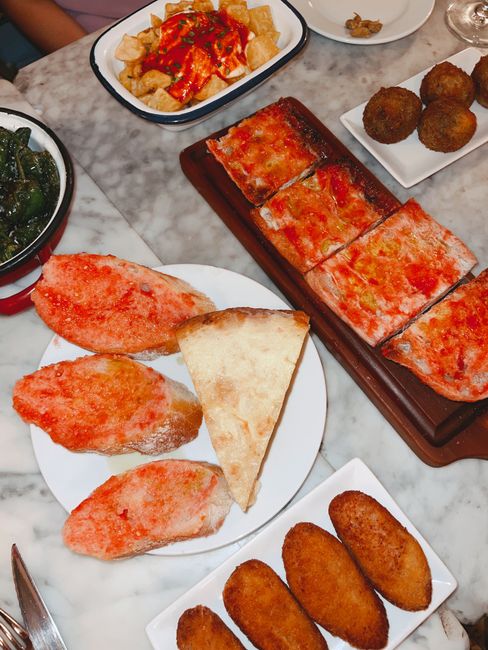
Thin slices of aubergine, fried until crisp and drizzled with dark sugarcane honey, are a sweet-and-salty tapa with roots in Moorish cooking. They are best eaten immediately, while still crackling. Most tapas bars in Córdoba serve a plate for €6–9, perfect to share with a glass of fino. Order them hot from the fryer.

Montilla-Moriles wine
Pale, dry fino and rich, sweet Pedro Ximénez wines from the Montilla-Moriles region, 45 km south of Córdoba, are the city's traditional drinks. Unlike sherry, the finos here are usually not fortified, because the grapes reach high sugar levels naturally. Old taverns such as Taberna Salinas serve a glass for €2–3.

Pastel cordobés
A round puff pastry filled with cabello de ángel, a sweet pumpkin jam, sometimes with a layer of ham, and dusted with sugar and cinnamon. It is eaten at breakfast or with coffee in the afternoon. Bakeries across Córdoba sell individual portions for €2–3 or whole cakes for €10–15. It keeps well for a picnic.

Salmorejo cordobés
Córdoba's signature dish is a thick, velvety cold soup of tomato, bread, garlic and olive oil, topped with chopped hard-boiled egg and strips of jamón. It is creamier than gazpacho and served in bowls, not glasses. Locals argue about the best version, and the city has a salmorejo brotherhood. Expect to pay €4–7.
Practical Travel Information
Transport & Accessibility
International Transport
Córdoba has no airport with regular commercial flights, so international visitors fly into Seville, about 140 km away, Málaga, about 160 km away, or Madrid. The main way to arrive is by high-speed train: Córdoba station lies on the Madrid–Seville AVE line, with trains to Madrid in about 1 hour 45 minutes, to Seville in 42 minutes and to Málaga in about one hour. Renfe, Ouigo and Iryo compete on the main route, keeping fares low when booked ahead. Long-distance buses from the station next to the railway connect with Granada, Jaén and other Andalusian cities.
Local Transport
Córdoba's historic centre is compact and best explored on foot: the train station to the Mezquita takes about 25 minutes walking, partly through the gardens of the Paseo de la Victoria. Aucorsa city buses connect the station with the centre, and line 3 runs close to the Mezquita. Single tickets cost around €1.30, with discounts on rechargeable cards. Taxis are inexpensive within the city. Driving is not recommended in the Judería, where streets are narrow and access is restricted. Cycling along the river is pleasant in the cooler months.
Safety & Health
Personal Safety
Córdoba is a very safe city with low crime levels. Pickpockets occasionally operate around the Mezquita and in crowded areas during the May festivals. As in Seville and Granada, some women offer rosemary sprigs near the Mosque-Cathedral and then ask for money, so politely refuse. The Judería and riverside are safe in the evening, but quieter outer neighbourhoods are less lively at night. The biggest risk for visitors is the extreme summer heat: drink water regularly, avoid walking in the afternoon and seek shade. In an emergency, call 112.
Medical Services
Hospital Universitario Reina Sofía is the main hospital in Córdoba, with a 24-hour emergency department and one of Spain's leading transplant units. EU visitors can use the European Health Insurance Card in public hospitals; others should have travel insurance. Pharmacies are plentiful in the centre, and night-duty pharmacies are listed on every pharmacy door. In summer, heatstroke and dehydration are common risks, so carry a water bottle and wear a hat. Tap water is safe to drink. For emergencies, dial 112.
Budget & Costs
Travel Costs
Córdoba is one of the cheapest cities in Spain for visitors. A hostel bed costs €18–35, a mid-range hotel €65–120 and a boutique hotel in a patio house €120–200, though prices rise during the May festivals. A menú del día costs €11–15, tapas €2.50–5 and dinner for two with wine €35–55. A glass of Montilla wine costs €2–3. The Mezquita costs about €13, the Alcázar about €5, and Medina Azahara is free for EU citizens. A mid-range traveller can enjoy Córdoba on €80–110 per day.
Budget Tips
Try the early-morning free hour at the Mezquita if it is running during your visit. Visit the Patios Festival in May, which is free. Walk between sights, as the historic centre is small. Eat salmorejo and flamenquín in taverns away from the Mezquita, where prices are lower. Visit in late autumn or winter for the cheapest hotels. Consider a day trip from Seville or Málaga if accommodation is expensive during festivals. Book train tickets two to three weeks ahead for the best fares.
Culture & Traditions
Social Norms
Cordobeses are polite and somewhat reserved, but friendly once you strike up a conversation. Greet with a hola or buenos días when entering shops and bars. Lunch is eaten from 14:00 to 16:00 and dinner after 21:00. Dress modestly inside the Mosque-Cathedral, which is an active Catholic cathedral where Mass is held. During the Patios Festival, respect the homes you visit: do not touch the plants, keep voices low and follow the queue. Tipping is not mandatory, but rounding up is appreciated.
Cultural Activities
Visit the Patios Festival in early May and the Battle of the Flowers on the first weekend of the month. See a flamenco show at a tablao near the Mezquita, or a performance in the Posada del Potro, a historic inn mentioned by Cervantes. Enjoy an evening at the Hammam Al Ándalus Arab baths. In late May, join the Feria de Nuestra Señora de la Salud. In summer, outdoor cinemas show films in patios across the city. Check the city's cultural agenda each week.
Unique Experiences in Córdoba
Visit the Mezquita during the early-morning free hour, when the forest of columns is almost silent and sunlight filters through the doors. Check the official website for current times, arrive 15 minutes early and head straight to the mihrab before the area closes for services.
Join the Patios Festival in the first two weeks of May and wander through the San Basilio district, where families open their geranium-filled courtyards to the public for free. Download the official route map and visit in the late afternoon when queues are shorter.
Attend the Night of the Mezquita, the evening light and sound show called El Alma de Córdoba, which tells the history of the building as you walk through the dimly lit columns. Tickets cost around €20 and should be booked a few days ahead.
Take a wine tour to Montilla, 45 km south, to visit traditional bodegas where fino and Pedro Ximénez wines age in old oak barrels. Tours with tastings cost around €15–30, and harvest season in September is the best time to visit.
Relax at the Hammam Al Ándalus near the Mezquita, an Arab bath with warm, hot and cold pools under arched ceilings. A 90-minute session with a short massage costs about €45–60, and evening slots are the most atmospheric. Bring a swimsuit.
Travel Recommendations for Córdoba
Stay at least one night in Córdoba rather than visiting only on a day trip. The Judería and the Roman Bridge are at thei…
Book Mezquita tickets online in spring, especially during Holy Week and May. Arrive at opening time and visit the bell t…
Plan your visit for spring or autumn. If you come in summer, follow the local rhythm: sightseeing from 8:30 to 12:00, a …
Visit Medina Azahara in the morning, as there is little shade at the site and temperatures rise quickly. Book a tourist …
Eat like a local in traditional tabernas such as Taberna Salinas or Bodegas Campos, ordering salmorejo, flamenquín and b…