Bilbao
Updated October 16, 2026
Also known as: Bilbo, Botxo
Main Landmarks in Bilbao

Museo Guggenheim Bilbao
Frank Gehry's titanium-clad museum, opened in 1997, transformed Bilbao into a cultural destination and remains its main attraction. Inside, Richard Serra's The Matter of Time fills a 130 m gallery with weathering steel spirals, alongside temporary exhibitions of modern and contemporary art. Outside stand Jeff Koons' Puppy and Louise Bourgeois' spider, Maman. Tickets cost around €18–20 and should be booked online with a time slot. Walk around the building at dusk, when the titanium changes colour. Allow at least two to three hours inside.
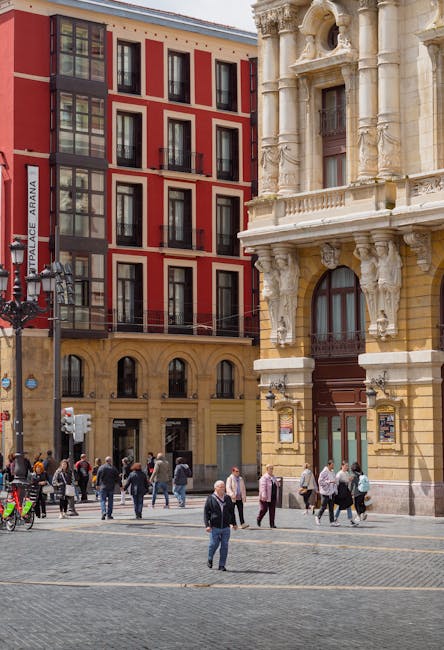
Casco Viejo and Siete Calles
The Casco Viejo is Bilbao's medieval old town, built around seven parallel streets, the Siete Calles, close to the river. Its narrow lanes are filled with pintxo bars, traditional shops and the Gothic Cathedral of Santiago, begun in the 14th century. The arcaded Plaza Nueva, completed in 1851, hosts a Sunday flea market and some of the city's best pintxo bars. Walk around at 19:00, when locals start their poteo. Many shops close at lunchtime and on Sundays. The Basque Museum stands nearby.

Mercado de la Ribera
The Ribera Market, rebuilt in 1929 in Art Deco style on the bank of the Nervión, is one of the largest covered markets in Europe, with about 10,000 m² of space. Its stalls sell fish from the Bay of Biscay, cheeses, peppers and Basque meat, and its ground floor has a lively gastrobar with pintxos and wine. Admire the stained glass and the river views from the terrace. Visit in the morning for the market and at midday for pintxos. It is closed on Sunday.

Puente de Vizcaya (Puente Colgante)
The Vizcaya Bridge, 20 minutes from the centre by metro, links Portugalete and Getxo across the mouth of the Nervión. Completed in 1893, it was the world's first transporter bridge and a UNESCO World Heritage Site since 2006. A gondola carries cars and people across in under two minutes for less than €1, and a lift takes visitors up to the 45 m walkway for panoramic views, for about €10. Combine it with a stroll through Getxo's seafront villas and the old port.

Funicular de Artxanda
The Artxanda funicular, opened in 1915, climbs from the Castaños area near the Zubizuri bridge to the top of Mount Artxanda in about three minutes. From the viewpoint you see the whole city, the river and the Guggenheim framed by green hills. At the top there are picnic areas, walking trails and traditional grill restaurants serving steak and grilled fish. A ticket costs under €2 each way. Go at sunset, and walk back down through the park if you prefer.

Museo de Bellas Artes de Bilbao
Bilbao's Fine Arts Museum, a short walk from the Guggenheim, holds one of Spain's most important art collections, with more than 10,000 works from the 12th century to today. Highlights include paintings by El Greco, Goya, Zurbarán, Gauguin and Basque painters such as Ignacio Zuloaga. A major extension by architects Norman Foster and Luis María Uriarte has added new galleries and a rooftop pavilion. Entry costs around €10 to €15, with reduced or free hours on some days. Allow two to three hours.

Azkuna Zentroa
Azkuna Zentroa, also called the Alhóndiga, is a former 1909 wine warehouse transformed by designer Philippe Starck into a cultural centre, opened in 2010. Its atrium is supported by 43 columns, each in a different style, inspired by world cultures and architecture. Inside are a cinema, library, exhibition spaces and a rooftop swimming pool with a glass bottom visible from below. Entry to the atrium is free, and it hosts concerts and exhibitions. Have a drink at the terrace and look up at swimmers.
History
Bilbao was founded in 1300, when the lord of Biscay, Diego López de Haro, granted a town charter to a small settlement on the right bank of the Nervión estuary. Its port quickly became the main gateway for exporting Castilian wool and Basque iron to Flanders and England. The original Casco Viejo was laid out on seven parallel streets, the Siete Calles, which still form the old town. In the 19th century Bilbao boomed as one of Spain's great industrial cities, with iron mines, blast furnaces, shipyards and banks, and wealthy families built the elegant Ensanche district across the river. The city resisted Carlist sieges in 1835 and 1874. In the late 20th century, the closure of steelworks and shipyards left unemployment above 25% and a polluted river. Bilbao responded with a bold regeneration plan: Norman Foster's metro opened in 1995, the Guggenheim Museum in 1997, and the riverbanks were cleaned and turned into promenades. The transformation became known worldwide as the Bilbao Effect. Today about 345,000 people live in the city, the centre of a metropolitan area of nearly one million.
Culture
Bilbaínos are known in Spain for their pride, humour and generosity, often joked about in stories of locals claiming everything in Bilbao is the biggest and best. Basque, Euskara, and Spanish are both official. Daily life revolves around the poteo, going from bar to bar for a small glass of wine and a pintxo, especially in the Casco Viejo and on Calle Ledesma. Football is a passion: Athletic Club, founded in 1898, plays only Basque-born or Basque-trained players and has never been relegated from the top division. The biggest festival is the Aste Nagusia, Great Week, in August, with nine days of concerts, fireworks contests, Basque sports and the giant figure of Marijaia. Bilbao is also a city of culture, with the Guggenheim, the Fine Arts Museum and the Euskalduna concert hall. Locals affectionately call their city Botxo, the hole, because it sits in a valley surrounded by green hills.
Climate
Spring
9–20°C
March to May brings mild 14–20°C days, green hills and frequent showers typical of the Atlantic climate. It is an excell…
Summer
15–26°C
June to September is pleasant, with 22–27°C days and occasional hot spells above 30°C when the south wind blows. It is t…
Autumn
10–23°C
September and October are often sunny and mild, with 17–24°C days, ideal for walking up Artxanda and visiting San Juan d…
Winter
5–13°C
December to February is cool and wet, with 9–13°C afternoons and rarely frost, as the sea moderates temperatures. It is …
Fun Facts
The world's oldest transporter bridge is nearby
The Vizcaya Bridge, completed in 1893 between Portugalete and Getxo at the mouth of the Nervión, was the first transport…
Metro entrances are glass worms
Bilbao's metro, designed by British architect Norman Foster and opened in 1995, is famous for its curved glass entrances…
Athletic Club fields only Basque players
Athletic Club, founded in 1898, has a long-standing policy of fielding only players born or trained in the Basque Countr…
A giant puppy guards the Guggenheim
Jeff Koons' Puppy, a 12 m tall West Highland terrier covered with about 38,000 flowering plants, has stood in front of t…
The river was once one of Europe's dirtiest
By the 1980s the Nervión estuary was so polluted by heavy industry that it had almost no oxygen and no fish. A clean-up …
A Game of Thrones island is 35 km away
San Juan de Gaztelugatxe, a tiny islet with a 10th-century hermitage on the coast 35 km from Bilbao, played Dragonstone …
Local Cuisine in Bilbao

Bacalao a la vizcaína
Salt cod cooked in a rich red sauce made from dried choricero peppers and onions, sweet rather than spicy. It is one of the classic dishes of Biscay and appears on menus in traditional restaurants and at home on special days. Expect to pay €18–25 for a plate in a restaurant in the Casco Viejo or the Ensanche.

Marmitako
A hearty fishermen's stew of fresh bonito tuna, potatoes, peppers and onions, simmered in a pot called a marmita. It is especially popular from June to September, when bonito is in season in the Bay of Biscay. Traditional restaurants and bars serve it for €12–18, and it is a favourite at coastal festivals.

Talo con chorizo
A thin, flat cornbread cooked on a griddle and wrapped around a grilled chorizo or local cheese, the classic street food of Basque festivals and markets. It is warm, soft and slightly smoky. Look for it at the Santo Tomás fair on 21 December and during the Aste Nagusia in August, for about €3–5.

Bollo de mantequilla
A soft, sweet bun filled with buttercream, a classic of Bilbao's bakeries since the early 20th century. Locals eat it for breakfast or as an afternoon snack with coffee. Historic pastry shops in the Casco Viejo and the Ensanche sell it for about €2–3. Buy them early, as the best bakeries often sell out by late afternoon.

Txakoli de Bizkaia
A fresh, slightly sparkling white wine from the hillsides of Biscay, with high acidity and low alcohol, perfect with pintxos and seafood. The Bizkaiko Txakolina designation covers vineyards around Bakio and Gernika. Bars pour it from a height into wide glasses. A glass costs €2.50–4, and winery visits near Bakio are a popular trip.

Pintxos bilbaínos
Bilbao's bars line their counters with elaborate pintxos, from anchovies and peppers to creative hot dishes such as grilled squid or mushroom croquettes. The best areas are the Plaza Nueva, the Siete Calles and Calle Ledesma in the Ensanche. A pintxo costs €2.50–4, and locals order one or two per bar with a small glass of wine called a txikito.
Practical Travel Information
Transport & Accessibility
International Transport
Bilbao Airport, 12 km north of the centre, is the main airport of the Basque Country, with a striking terminal by Santiago Calatrava and direct flights to many European cities. Renfe trains from the Abando station connect Bilbao with Madrid in about 5 hours, and the Basque high-speed rail line, known as the Basque Y, is under construction. ALSA and Pesa buses from the Bilbao Intermodal station link the city with San Sebastián in about 1 hour 15 minutes, Santander in about 1 hour 15 minutes and other Spanish cities. Ferries from Santurtzi, near Bilbao, sail to Portsmouth in the UK.
Local Transport
Bilbao's centre is compact and walkable, and the riverside promenade connects the Guggenheim with the Casco Viejo in about 20 minutes on foot. The metro, with two lines, links the centre with Getxo, the beaches and the Vizcaya Bridge; a single ticket costs around €1.80, cheaper with the Barik card. The Euskotram tram runs along the river past the Guggenheim and the Euskalduna. Bilbobus city buses cover the rest. The Artxanda funicular and public lifts help with hills. Bike rental is available, and many streets in the centre are pedestrian.
Safety & Health
Personal Safety
Bilbao is one of the safest large cities in Spain, with low violent crime. Pickpocketing can occur in crowded places such as the Casco Viejo, the Ribera Market, metro stations and during the Aste Nagusia festival in August and Athletic Club matches. Keep phones and wallets secure in busy bars. Some areas on the left bank, such as parts of San Francisco and Bilbao La Vieja, can feel rough late at night, so take care and stay on main streets. In an emergency, call 112, with English-speaking operators.
Medical Services
Hospital Universitario de Cruces, in Barakaldo, and Hospital Universitario Basurto are the main public hospitals, both with 24-hour emergency departments. Private clinics such as IMQ Zorrotzaurre also offer care for visitors. EU travellers can use the European Health Insurance Card in public hospitals; others should have travel insurance. Pharmacies are easy to find, with night-duty pharmacies listed on their doors. Tap water is of excellent quality. The main health concern for visitors is slippery streets on rainy days in the steep old town.
Budget & Costs
Travel Costs
Bilbao is cheaper than San Sebastián and Barcelona but more expensive than southern Spanish cities. A hostel bed costs €25–45, a mid-range hotel €90–150 and a four-star hotel near the Guggenheim €150–250. A pintxo costs €2.50–4, a txikito of wine €1.50–2.50 and a menú del día €14–18. Dinner for two with wine at a good restaurant costs €60–90. The Guggenheim costs about €18–20, the Artxanda funicular under €2 and the Vizcaya Bridge gondola under €1. A mid-range traveller should budget €110–150 per day.
Budget Tips
Eat a menú del día at lunch, which often includes three courses and wine for €14–18. Do the poteo in the Casco Viejo instead of a full dinner. Buy a Barik card for cheaper metro, tram and bus rides. The Bilbao Bizkaia Card includes transport and museum entries and can save money for visitors planning several visits. Many attractions are free, including Azkuna Zentroa, the riverside promenade and the old town. Visit in winter or late autumn for lower hotel prices.
Culture & Traditions
Social Norms
Bilbaínos are friendly, direct and proud of their city, and humour about local pride is common. Greet with kaixo or hola, and two kisses among friends. In bars, the poteo means having one small drink and one pintxo before moving on; pay at the end. Lunch starts around 13:30 and dinner around 20:30–21:00. Respect the Basque language and avoid political debates. Football matters, so be respectful about Athletic Club. Tipping is optional, though rounding up or leaving small change is common in bars.
Cultural Activities
Join the Aste Nagusia in August, with nine days of concerts, fireworks and Basque sports. Watch Athletic Club at the new San Mamés stadium. Visit the Guggenheim and the Fine Arts Museum, and attend a concert or opera at the Euskalduna Palace. On 21 December, join the Santo Tomás fair, when the city fills with farmers' stalls and talo con chorizo. Explore Bilbao's street art in Bilbao La Vieja. Take a pintxo tour, and visit the Basque Museum in the Casco Viejo to learn about local traditions.
Unique Experiences in Bilbao
Ride the gondola across the Vizcaya Bridge, the world's first transporter bridge from 1893, then take the lift to the 45 m walkway for views over the river mouth and the Bay of Biscay. The gondola costs under €1 and the walkway about €10.
Climb the 241 steps to the hermitage of San Juan de Gaztelugatxe, the Dragonstone of Game of Thrones, about 45 minutes from Bilbao, and ring the bell three times for good luck. Entry is free, but timed tickets are required online from June to October.
Do the poteo through the Siete Calles and Plaza Nueva at 19:00, ordering a txikito of wine and one pintxo in each bar, as locals have done for generations. A full evening costs €20–35 per person and is best on Thursday or Friday.
Watch an Athletic Club match at San Mamés, nicknamed the Cathedral, where the team plays only Basque-trained players and the crowd sings throughout the game. Tickets cost €40–100, and stadium tours with the museum are available for about €15. Book ahead for big games.
Take a day trip to a txakoli winery near Bakio or Gernika, tasting the slightly sparkling white wine among green vineyards overlooking the sea. Tours with tasting cost €15–30, and you can combine them with Gaztelugatxe and the beach at Bakio.
Travel Recommendations for Bilbao
Visit the Guggenheim early in the morning or late afternoon to avoid tour groups, and walk around the outside of the bui…
Use Bilbao as a base for the Basque coast. The metro reaches the beaches of Getxo and Sopelana in about 30 minutes, the …
Always carry a waterproof jacket or umbrella. Bilbao's climate is mild but wet, with rain possible in any season. Comfor…
Plan your evening around the poteo rather than a single restaurant. Start around 19:00 in the Plaza Nueva or Calle Ledes…
Combine Bilbao with San Sebastián for a complete Basque experience. They are only about one hour apart by bus, with freq…