Czech Republic
Updated October 19, 2026
The Czech Republic, or Czechia, is a landlocked country in Central Europe, bordered by Germany, Poland, Slovakia and Austria, with about 10.9 million people. It is made up of the historic lands of Bohemia, Moravia and part of Silesia. Prague, its capital, on the Vltava River, has one of Europe's bes…
Popular Cities in Czech Republic

Must-See Places in Czech Republic

Prague Castle and Charles Bridge
The largest ancient castle complex in the world, with St Vitus Cathedral, above a 14th-century stone bridge lined with statues.

Český Krumlov Castle
A Renaissance castle with a painted tower and a Baroque theatre above a medieval town on the bends of the Vltava.

Sedlec Ossuary
A chapel decorated with the bones of tens of thousands of people, near the silver-mining town of Kutná Hora.

Karlovy Vary Colonnades
Elegant colonnades with hot mineral springs in the most famous spa town of West Bohemia.

Pilsner Urquell Brewery
The brewery where the first golden lager was brewed in 1842, with tours of historic cellars.

Holy Trinity Column
A towering Baroque column in Olomouc's main square, listed by UNESCO.

Telč Main Square
A square lined with colourful Renaissance houses with arcades, in a town surrounded by ponds.

Villa Tugendhat
A modernist villa by Mies van der Rohe in Brno, a masterpiece of 20th-century architecture.
Must-Visit Attractions in Czech Republic

Kutná Hora, about 70 km east of Prague, with about 21,000 people, was
Its historic centre, listed by UNESCO since 1995, includes the Cathedral of St Barbara, a Gothic masterpiece dedicated to the patron saint of miners, with flying buttresses and tent-like roofs, the Italian Court, the former royal mint, the Stone House and the Czech Silver Museum, where visitors can explore a medieval mine with helmets and lamps. In the district of Sedlec, the Sedlec Ossuary is decorated with the bones of tens of thousands of people, and the Cathedral of the Assumption is an example of Baroque Gothic. Kutná Hora is an easy day trip from Prague by train, about one hour. Insider tip: buy a combined ticket for the ossuary and the Sedlec cathedral, and walk from the ossuary to St Barbara's, about 30 minutes, or take a local bus.
Unique Experiences in Czech Republic
Walk Across Charles Bridge at Dawn
Cross Charles Bridge at sunrise, before the crowds, when the Baroque statues stand in silhouette against Prague Castle and mist rises from the Vltava.
Taste Beer at the Source
Take a brewery tour in Plzeň at Pilsner Urquell or in České Budějovice at Budvar, tasting unfiltered lager drawn from oak barrels in historic cellars.
Explore Castles and Châteaux
Visit some of the country's thousands of castles and châteaux, such as Karlštejn, Hluboká, Konopiště and the Lednice-Valtice cultural landscape, with guided tours of rooms, gardens and towers.
Hike Bohemian Switzerland
Hike among sandstone towers, gorges and forests in Bohemian Switzerland National Park, crossing Pravčická brána, the largest natural sandstone arch in Europe, and taking a boat through the Edmund Gorge.
Visit Christmas Markets
Experience the Christmas markets of Prague, Brno, Český Krumlov and other towns, with wooden stalls, giant trees, nativity scenes, carols, mulled wine and live carp sold in tubs for Christmas Eve dinner.
Travel Tips for Czech Republic
Look Beyond Prague
Prague is wonderful but very crowded, so spend time in other towns, such as Český Krumlov, Kutná Hora, Olomouc, Telč and…
Pay in Czech Koruna
The Czech Republic uses the Czech koruna, CZK, not the euro, although some tourist shops accept euros at poor rates. Car…
Travel by Train and Bus
Czech trains and buses are cheap, comfortable and punctual, connecting all major towns. Use České dráhy, RegioJet and Le…
Visit in Shoulder Season
Visit in May, June or September for pleasant weather and fewer crowds than in July and August, when Prague and Český Kru…
Learn Pub Etiquette
In Czech pubs, hospoda, it is normal to share tables, asking je tu volno, is this free. Waiters bring beer automatically…
Avoid Tourist Traps
In Prague, avoid restaurants with touts and photo menus around the Old Town Square and Charles Bridge, where prices can …
Must-Try Local Dishes

Svíčková na smetaně
Svíčková na smetaně, the most famous Czech dish, is marinated beef sirloin served with a creamy sauce of root vegetables, such as carrots, celeriac and parsley root, with bread dumplings, cranberries, whipped cream and a slice of lemon. It is a traditional Sunday lunch. A portion costs about 220–350 CZK in restaurants. Try it in a traditional pub.
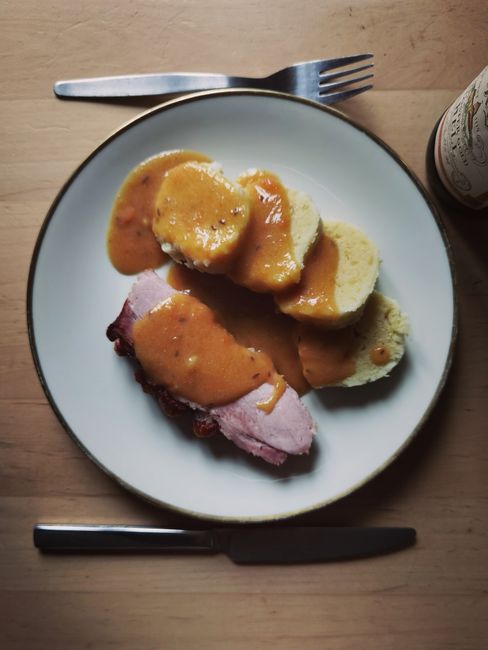
Vepřo knedlo zelo
Vepřo knedlo zelo, roast pork with dumplings and sauerkraut, is considered the national dish of the Czech Republic, with slow-roasted pork, flavoured with caraway, served with bread or potato dumplings and stewed cabbage. A portion costs about 200–320 CZK. Try it with a glass of Czech lager in a traditional pub.

Guláš
Czech goulash, guláš, is a thick beef stew with onions, paprika and caraway, served with bread dumplings and often sliced onion on top. It is lighter in paprika than Hungarian goulash and is often eaten with beer. A portion costs about 180–300 CZK. Try it in a pub, sometimes served in a bread bowl.

Smažený sýr
Smažený sýr, fried cheese, is a slice of Edam or Hermelín cheese coated in breadcrumbs and fried, served with tartar sauce and French fries or boiled potatoes, a popular comfort food and street snack. A portion costs about 150–250 CZK in restaurants or about 100 CZK at street stalls. Try it at Wenceslas Square.

Pilsner Lager
Czech lager, such as Pilsner Urquell, Budvar, Kozel and many small breweries, is served with a thick head of foam, often poured in different styles, such as hladinka, a classic pour, šnyt, half foam, and mlíko, almost all foam. A half-litre costs about 50–90 CZK in pubs. Visit the Pilsner Urquell brewery in Plzeň.

Trdelník
Trdelník, a sweet pastry of rolled dough wrapped around a stick, grilled and coated with sugar and nuts, is sold everywhere in Prague, often filled with ice cream. It is originally from Slovakia and Hungary rather than a Czech tradition, but it has become a popular tourist snack. It costs about 100–200 CZK. Try a plain one fresh from the grill.

Koláče
Koláče are round pastries made of sweet yeast dough, filled with poppy seeds, plum jam, tvaroh, a fresh curd cheese, or apricots, a traditional dessert served at weddings and festivals, especially in Moravia. A koláč costs about 30–60 CZK in bakeries. Try them with coffee in a café or at a village bakery.

Moravian Wine
South Moravia, around Mikulov, Valtice and Znojmo, produces most of the Czech Republic's wine, especially white wines, such as Grüner Veltliner, Riesling and Pálava, and red wines, such as Frankovka. Wine cellars, sklepy, offer tastings. A glass costs about 60–120 CZK. Visit in autumn for burčák, young fermenting wine. Ask for local wine.
History
Celts, Slavs and the Přemyslid Dynasty
The name Bohemia comes from the Boii, a Celtic tribe who lived in the region from about the 4th century BC. They were followed by Germanic tribes, and from the 6th century AD by Slavic peoples. In the 9th century, the Great Moravian Empire became the first major Slavic state in the region, and in 863 the Byzantine missionaries Cyril and Methodius arrived to spread Christianity, creating the Glagolitic alphabet for the Slavic language.
The rise of Bohemia
From the late 9th century, the Přemyslid dynasty united the Czech tribes, with its seat at Prague Castle. Prince Wenceslas, the Good King Wenceslas of the English carol, was murdered by his brother Boleslaus in 935 and became the patron saint of the Czech lands. In 1198 Bohemia became a kingdom within the Holy Roman Empire. Under kings such as Ottokar II, in the 13th century, Bohemia grew rich from silver mines, especially at Kutná Hora, and German settlers founded towns and brought new crafts. The Přemyslid line ended in 1306, when King Wenceslas III was murdered, and in 1310 the Luxembourg dynasty took the throne, starting a golden age for Prague.
Climate & Best Time to Visit
Spring
1–19°C
March to May is fresh and changeable, with temperatures rising from about 8°C in March to 18–20°C in May, blossoming orc…
Summer
12–25°C
June to August is warm, with days of about 23–26°C, occasionally reaching 30–35°C during heatwaves, and afternoon thunde…
Autumn
2–19°C
September to November brings mild days of about 18–20°C in September, falling to about 5–8°C in November, golden forests…
Winter
-4–3°C
December to February is cold, with days of about 0–3°C, nights below freezing, short daylight and occasional snow. Chris…
Fascinating Fun Facts
The birthplace of Pilsner
In 1842 the Bavarian brewer Josef Groll brewed the first golden lager in Plzeň, using soft local water, Saaz hops and pa…
The world's oldest working astronomical clock
The Prague Astronomical Clock, Orloj, on the Old Town Hall, was installed in 1410, making it the third oldest astronomic…
The country with the most castles
The Czech Republic has one of the highest densities of castles and châteaux in the world, with more than 2,000 castles, …
The word robot is Czech
The word robot was introduced by the Czech writer Karel Čapek in his play R.U.R., Rossum's Universal Robots, first perfo…
A church decorated with bones
The Sedlec Ossuary, in Kutná Hora, is a small chapel decorated with the bones of about 40,000 to 70,000 people, arranged…
A nation of hikers
The Czech Republic has one of the densest networks of marked hiking trails in the world, about 40,000 km, maintained sin…
Traveler Reviews (0 reviews)
Sign in to leave a review and share your experience.
Sign InNo reviews yet. Be the first to share your experience!