South Korea
Updated October 19, 2026
South Korea occupies the southern half of the Korean Peninsula, in East Asia, bordered by North Korea and surrounded by the Yellow Sea, the East Sea and the Korea Strait, with about 3,000 islands, the largest being Jeju. About 51 million people live here, half of them in the Seoul metropolitan area.…
Must-See Places in South Korea
Gyeongbokgung Palace
The largest of Seoul's five Joseon palaces, built in 1395, with a changing of the guard ceremony and hanbok-wearing visitors.
Gamcheon Culture Village
A hillside neighbourhood of colourful houses, alleys and street art in Busan, built by refugees during the Korean War.
Hallasan and Seongsan Ilchulbong
South Korea's highest mountain and a volcanic tuff cone on Jeju, part of a UNESCO natural heritage site.
Bulguksa Temple and Seokguram
An 8th-century Buddhist temple and a granite grotto with a seated Buddha, masterpieces of Silla art near Gyeongju.
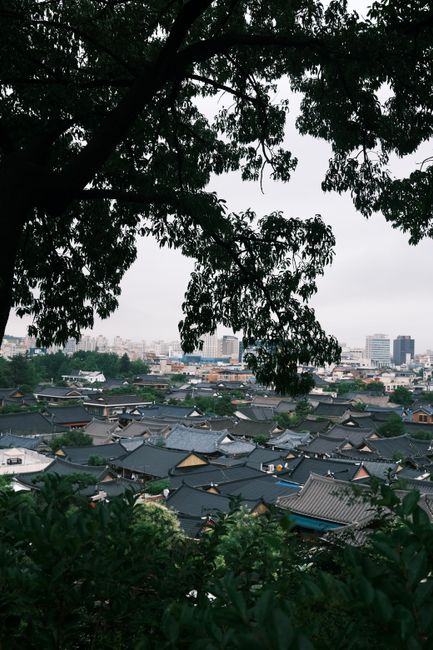
Jeonju Hanok Village
More than 700 traditional hanok houses, the birthplace of bibimbap and a centre of Korean food culture.
Seoraksan National Park
Granite peaks, waterfalls and temples near Sokcho, famous for autumn colours and hiking trails.
Hwaseong Fortress
An 18th-century fortress wall about 5.7 km long surrounding the old centre of Suwon, a UNESCO site.
Hahoe Folk Village
A Joseon-era clan village of thatched and tiled houses in a river bend, famous for its mask dance.
Unique Experiences in South Korea
Wear Hanbok in a Palace
Rent a hanbok, traditional Korean clothing, and walk through Seoul's royal palaces, such as Gyeongbokgung and Changdeokgung, taking photos among pavilions and gardens.
Stay in a Buddhist Temple
Join a temple stay programme at a Buddhist temple, waking before dawn for chanting, meditating with monks, eating vegetarian temple food and joining the tea ceremony.
Visit the DMZ
Take a guided tour to the Demilitarized Zone, visiting observation posts, infiltration tunnels dug by North Korea and the Joint Security Area at Panmunjom, when open.
Hike a Korean Mountain
Join Koreans on their favourite pastime, hiking well-marked mountain trails in national parks, such as Seoraksan, Bukhansan and Hallasan, with temples, viewpoints and autumn colours.
Relax in a Jjimjilbang
Spend an evening in a jjimjilbang, a Korean bathhouse with hot pools, saunas, steam rooms, relaxation halls and snack bars, where families and friends relax, eat and even sleep.
Travel Tips for South Korea
Get a T-money Card and Use Public Transport
Buy a T-money or similar rechargeable card at convenience stores to use on subways, buses and taxis across most of Korea…
Check K-ETA and Entry Rules
Visitors from many visa-exempt countries need a K-ETA, an electronic travel authorisation, applied for online before dep…
Visit in Spring or Autumn
Plan your trip for April, for cherry blossoms, or October and early November, for autumn foliage and clear skies, the mo…
Follow Dining Etiquette
Korean dining has customs: wait for the eldest to start eating, do not stick chopsticks upright in rice, pour drinks for…
Carry a Card and Some Cash
Credit cards are accepted almost everywhere, even for small amounts, and mobile payments are common. Some foreign cards …
Respect Quiet and Personal Space Norms
Koreans value politeness and quiet in public, so speak softly on subways and buses, and avoid phone calls. Priority seat…
Must-Try Local Dishes

Korean BBQ
Korean barbecue, gogi-gui, is meat, such as pork belly, samgyeopsal, marinated beef, bulgogi, and short ribs, galbi, grilled at the table and wrapped in lettuce with garlic, chilli and ssamjang sauce, eaten with many side dishes, banchan. A meal costs about 15,000–40,000 KRW per person. Try it with soju in a busy restaurant.
Bibimbap
Bibimbap is a bowl of rice topped with sautéed vegetables, beef, a fried egg and gochujang, red chilli paste, mixed together before eating. Jeonju's version is the most famous, and dolsot bibimbap is served in a hot stone bowl, making the rice crispy. A bowl costs about 9,000–15,000 KRW. Try it in Jeonju.
Kimchi
Kimchi, fermented vegetables, mainly napa cabbage or radish, seasoned with chilli powder, garlic, ginger and fish sauce, is served with almost every meal, and there are hundreds of varieties. It is also used in stews, fried rice and pancakes. Try a kimchi-making class to learn about kimjang, the UNESCO-listed tradition.
Tteokbokki
Tteokbokki, chewy rice cakes simmered in a sweet and spicy gochujang sauce, often with fish cakes and boiled eggs, is Korea's favourite street food, sold at stalls and markets. A portion costs about 4,000–8,000 KRW. Try it at Gwangjang Market in Seoul or at a street stall at night. Many stalls add cheese.
Korean Fried Chicken
Korean fried chicken, double-fried for an extra crispy coating, served plain or coated in sweet and spicy yangnyeom sauce or soy garlic, is eaten with beer, a combination called chimaek. It is a favourite late-night meal and delivery food. A whole chicken costs about 18,000–25,000 KRW. Try it while watching a baseball game.
Samgyetang
Samgyetang is a whole young chicken stuffed with sticky rice, ginseng, jujube dates and garlic, simmered in a light broth, traditionally eaten on the hottest days of summer, boknal, to restore energy. A bowl costs about 15,000–25,000 KRW. Try it at Tosokchon, a famous restaurant near Gyeongbokgung in Seoul. Expect a queue at lunch.
Naengmyeon
Naengmyeon, cold buckwheat noodles served in an icy beef broth with pear, cucumber and egg, or with spicy sauce, bibim naengmyeon, is a refreshing summer dish originally from North Korea. A bowl costs about 10,000–16,000 KRW. Cut the noodles with scissors, and add mustard and vinegar to taste. It is especially popular in summer.
Soju and Makgeolli
Soju, a clear, mild spirit, about 16–20% alcohol, is Korea's national drink, poured for others, never for yourself, while makgeolli, a milky rice wine, is drunk with savoury pancakes, jeon, especially on rainy days. A bottle costs about 4,000–6,000 KRW in restaurants. Turn away from elders when drinking. Say geonbae when toasting.
History
Ancient Korea and the Three Kingdoms
According to legend, Korea's first kingdom, Gojoseon, was founded in 2333 BC by Dangun, the son of a heavenly prince and a bear who became a woman, and Koreans celebrate National Foundation Day on 3 October. The peninsula has been inhabited since prehistoric times, and the dolmen sites of Gochang, Hwasun and Ganghwa, a UNESCO site, hold thousands of megalithic tombs, among the largest concentrations in the world. From the 1st century BC, the Three Kingdoms emerged: Goguryeo in the north, Baekje in the south-west and Silla in the south-east, with Gaya, a confederation, in the south.
Unified Silla
The Three Kingdoms competed for centuries, adopting Buddhism, Chinese writing and culture. Baekje transmitted Buddhism and arts to Japan. In 668, with the help of China's Tang dynasty, Silla unified most of the peninsula, beginning the Unified Silla period, a golden age of Buddhist art and science. Its capital, Gyeongju, was one of the largest cities in the world, and its monuments, such as the Bulguksa Temple, the Seokguram Grotto and the Cheomseongdae observatory, built in the 7th century, are UNESCO sites. In the north, Balhae, a successor state of Goguryeo, ruled Manchuria until 926.
Climate & Best Time to Visit
Spring
5–23°C
March to May brings mild, sunny weather, with days rising from about 10°C in March to about 23°C in May, and cherry blos…
Summer
21–31°C
June to August is hot and humid, with days of about 28–32°C, and the rainy season, jangma, from late June to late July, …
Autumn
7–25°C
September to November is the best season, with clear skies, dry air, days of about 15–25°C and spectacular autumn foliag…
Winter
-7–4°C
December to February is cold and dry, with days of about 0–5°C in Seoul, nights often below −10°C, cold winds from Siber…
Fascinating Fun Facts
An alphabet created by a king
Hangul, the Korean alphabet, was created in 1443 by King Sejong the Great and his scholars, and published in 1446, so th…
Oldest surviving metal-type book
The Jikji, a Buddhist text printed in 1377 at the Heungdeoksa Temple in Cheongju, is the oldest surviving book printed w…
Everyone gets older on New Year
Traditionally, Koreans counted age so that babies were one year old at birth, and everyone gained a year on New Year's D…
The world's fastest internet
South Korea has one of the fastest and most widespread internet networks in the world, and it was one of the first count…
Kimchi has its own month
Kimchi, fermented vegetables, mainly napa cabbage, with chilli, garlic and fish sauce, is eaten with almost every meal i…
A border that became a wildlife refuge
The Demilitarized Zone, the DMZ, about 250 km long and 4 km wide, separating North and South Korea since 1953, has been …
Traveler Reviews (0 reviews)
Sign in to leave a review and share your experience.
Sign InNo reviews yet. Be the first to share your experience!