Greece
Updated October 19, 2026
Greece, in south-eastern Europe, is the birthplace of democracy, philosophy, theatre and the Olympic Games, and its ancient temples, theatres and sanctuaries still stand on hilltops and by the sea. It has about 10.4 million people and a coastline of about 13,600 km, with some 6,000 islands and islet…
Must-See Places in Greece
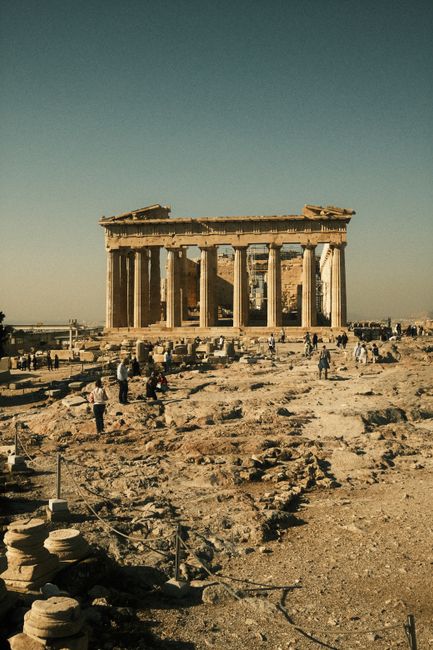
Acropolis of Athens
The Acropolis, a rocky hill above Athens and a UNESCO site, holds the Parthenon, completed in 432 BC and dedicated to Athena, as well as the Erechtheion, with its Caryatids, and the Propylaia gateway. Tickets cost about €30 from April to October. Book a timed slot online, and arrive at opening at 8:00 to avoid heat and crowds.

Oia Village
Oia, at the northern tip of Santorini, is famous for white houses and blue-domed churches clinging to the caldera cliffs, and for its sunsets, among the most photographed in the world. Crowds gather at the castle ruins each evening. Entry is free. Arrive at least an hour before sunset, or watch from quieter Imerovigli or a boat.
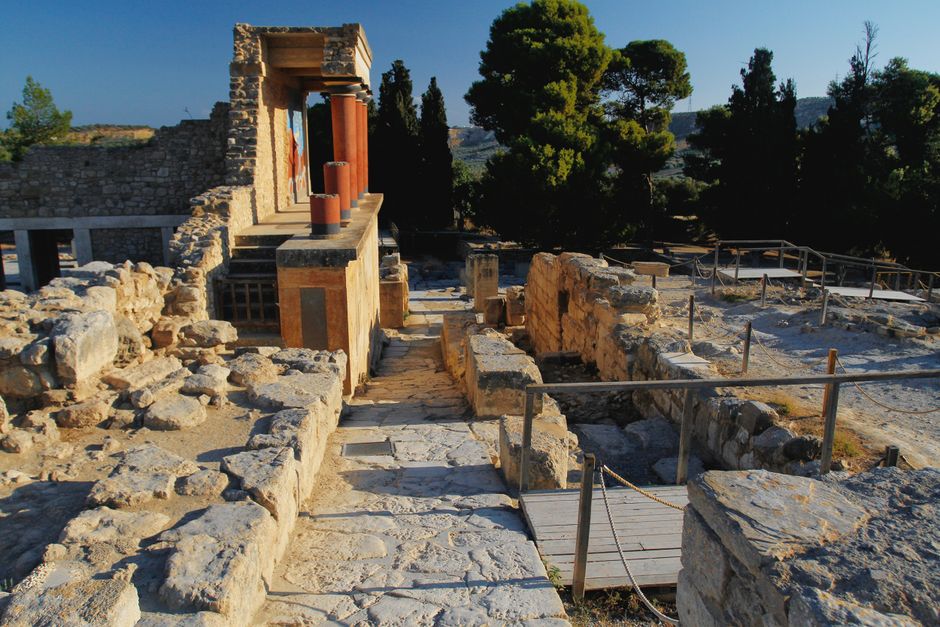
Palace of Knossos
The Palace of Knossos, about 5 km from Heraklion, was the centre of the Minoan civilisation, with remains of royal rooms, storerooms and colourful frescoes, partly reconstructed by Arthur Evans in the early 20th century. It is linked to the legend of the Minotaur. Tickets cost about €20. Visit early in the morning, and combine it with the Heraklion Archaeological Museum.

Meteora Monasteries
Meteora, near Kalambaka in central Greece, is a UNESCO site where six active Orthodox monasteries stand on top of huge sandstone pillars rising up to about 400 m. Monks first settled here in the 11th century. Each monastery costs about €3–5, and opening days vary. Dress modestly, with skirts for women, and watch the sunset from the viewpoints.

Medieval City of Rhodes
The Medieval City of Rhodes, a UNESCO site, is one of the best-preserved fortified towns in Europe, built by the Knights of St John, who ruled the island from 1309 to 1522. Highlights include the Palace of the Grand Master and the Street of the Knights. Walking the old town is free. Visit in the evening, when the streets are cooler and quieter.

Old Town of Corfu
Corfu's Old Town, a UNESCO site, combines Venetian fortresses, French-style arcades and British Neoclassical buildings, reflecting centuries of foreign rule. The Liston promenade and the Spianada square are lively in the evening. Walking is free, and the Old Fortress costs about €10. Explore the narrow lanes, called kantounia, and eat kumquat sweets.

Balos Lagoon
Balos Lagoon, in north-west Crete, about 1.5 hours from Chania, is a shallow turquoise lagoon with pink and white sand, overlooked by the Gramvousa peninsula. It is reached by boat from Kissamos or by a rough road and a 20-minute walk. Parking costs a few euros. Visit early or late, bring water and shade, and protect the fragile environment.

White Tower of Thessaloniki
The White Tower, a 15th-century Ottoman tower on Thessaloniki's waterfront, is the symbol of the city and houses a museum of its history. The seafront promenade, Nea Paralia, is lively at sunset. Entry costs about €6. Combine it with the city's UNESCO-listed Byzantine churches and the Rotunda, and enjoy bougatsa for breakfast.
Unique Experiences in Greece
Island Hop by Ferry
Travel between Greek islands by ferry, from the Cyclades, such as Mykonos, Paros, Naxos and Santorini, to the Dodecanese and Crete, enjoying the views from the deck.
Sail the Santorini Caldera
Sail around the volcanic caldera of Santorini on a catamaran or traditional boat, swimming in hot springs, walking on the volcano and watching the sunset from the sea.
Hike the Samaria Gorge
Hike through the Samaria Gorge in western Crete, one of Europe's longest gorges, about 16 km long, with walls up to 300 m high, ending at the Libyan Sea.
Celebrate Greek Easter
Join the most important Greek festival, with candlelit processions on Good Friday, the midnight Resurrection service, fireworks and a feast of roast lamb on Easter Sunday.
Watch a Play in an Ancient Theatre
See ancient Greek drama, opera or concerts in theatres used for more than 2,000 years, such as Epidaurus and the Odeon of Herodes Atticus in Athens.
Travel Tips for Greece
Visit in the Shoulder Season
May, June, September and early October offer warm weather, a warm sea, open hotels and fewer crowds than July and August…
Book Archaeological Sites Online
Major sites, such as the Acropolis, now use timed tickets booked online through the official Hellenic Heritage website. …
Plan Ferries and Flights Carefully
Island hopping requires planning, as ferry schedules change by season and weather. Check routes on official ferry websit…
Respect Churches and Monasteries
When visiting Orthodox churches and monasteries, such as those at Meteora and Mount Athos, dress modestly, covering shou…
Carry Cash and Learn a Few Words
Cards are widely accepted, but small tavernas, kiosks and island shops may prefer cash. Tipping of 5–10% is appreciated …
Protect Yourself from the Summer Heat
Summer heatwaves can reach above 40°C, and some archaeological sites close at midday during extreme heat. Drink plenty o…
Must-Try Local Dishes

Moussaka
A baked dish of layered aubergine, minced lamb or beef cooked with tomato, cinnamon and allspice, and a thick, creamy béchamel topping. The modern version was popularised in the 1920s by the chef Nikolaos Tselementes. It is served in tavernas across Greece, often as a portion cut from a large tray. A plate costs about €10–15.
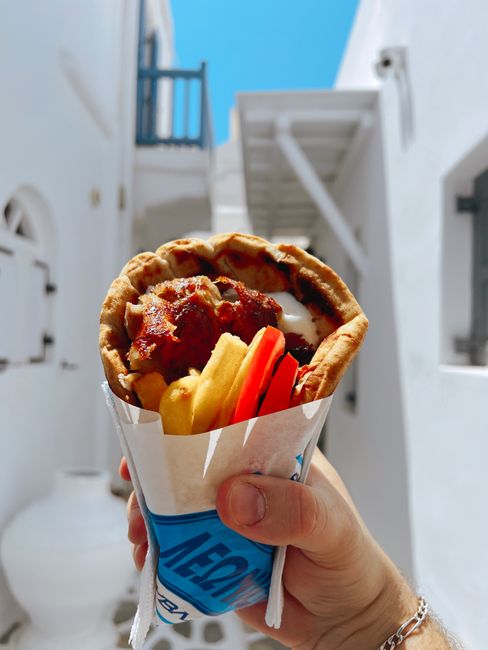
Souvlaki and Gyros
Souvlaki, pieces of grilled pork or chicken on skewers, and gyros, meat cooked on a vertical rotisserie, are Greece's favourite street foods. They are wrapped in pita bread with tomato, onion, tzatziki and sometimes chips. Every town has souvlaki shops, called souvlatzidiko. A pita wrap costs about €3.50–5, one of the cheapest meals in Greece.
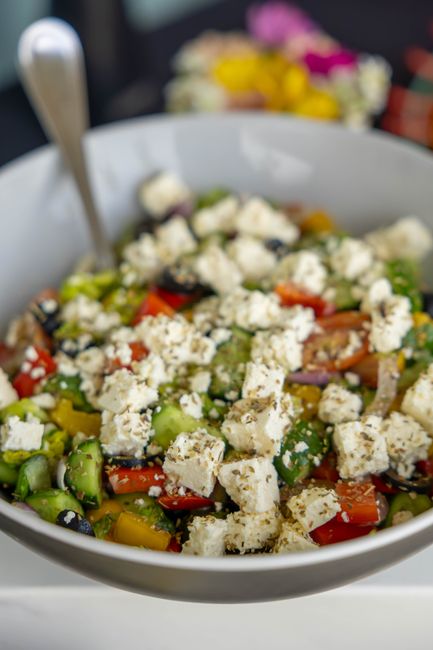
Greek Salad
Horiatiki, village salad, made with ripe tomatoes, cucumber, red onion, green pepper, Kalamata olives and a thick slab of feta cheese, dressed with olive oil and oregano. It contains no lettuce. Feta, a brined cheese made from sheep's or goat's milk, has protected status in the EU. A salad costs about €8–12 and is enough to share as a starter.
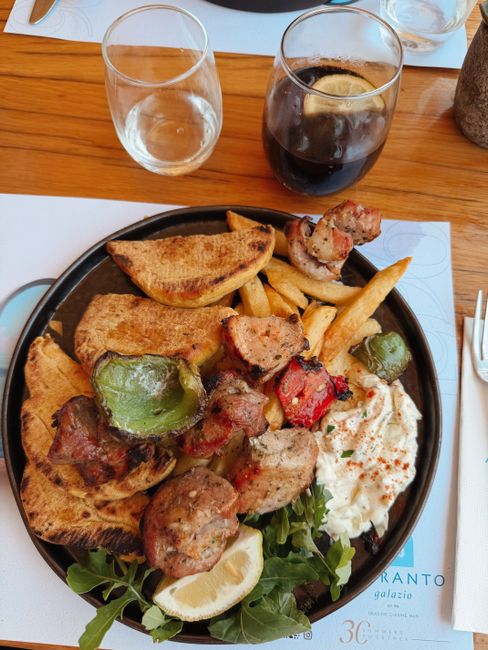
Fresh Seafood
Greece's islands and coastal towns serve grilled octopus, calamari, sardines, red mullet, sea bream and shrimp, often caught the same day. Fish is usually priced by the kilo, so ask before ordering. Octopus hung to dry in the sun outside tavernas is a classic island sight. A grilled fish meal costs about €15–30 per person, more for premium fish.
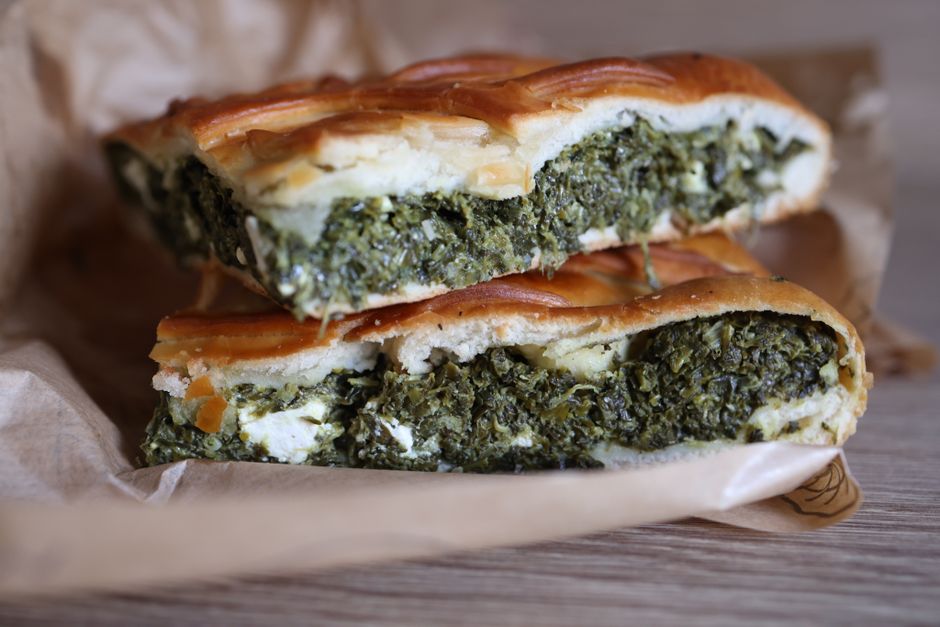
Spanakopita
A savoury pie of crispy filo pastry filled with spinach, feta, onions and herbs, such as dill. Other popular pies, called pites, include tiropita, cheese pie, and bougatsa, filled with custard or cheese, popular in Thessaloniki. Bakeries sell them warm in the morning. A slice costs about €2–3, a common breakfast on the go.
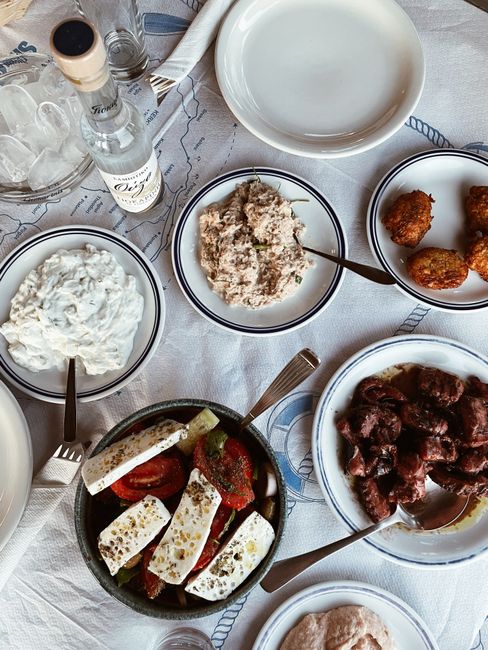
Mezedes
Small dishes shared with drinks, such as tzatziki, yoghurt with cucumber and garlic, taramosalata, fish roe dip, fava, yellow split pea purée, dolmades, stuffed vine leaves, keftedes, meatballs, and saganaki, fried cheese. They are traditionally eaten with ouzo or tsipouro in ouzeries. Each meze costs about €4–8. Order several to share.

Baklava and Loukoumades
Baklava is a rich dessert of layered filo pastry filled with chopped walnuts or pistachios and soaked in honey syrup. Loukoumades are small fried dough balls drizzled with honey and cinnamon, sometimes with walnuts or chocolate. Greek yoghurt with thyme honey is also a classic dessert. A portion costs about €4–7 in patisseries and cafés.
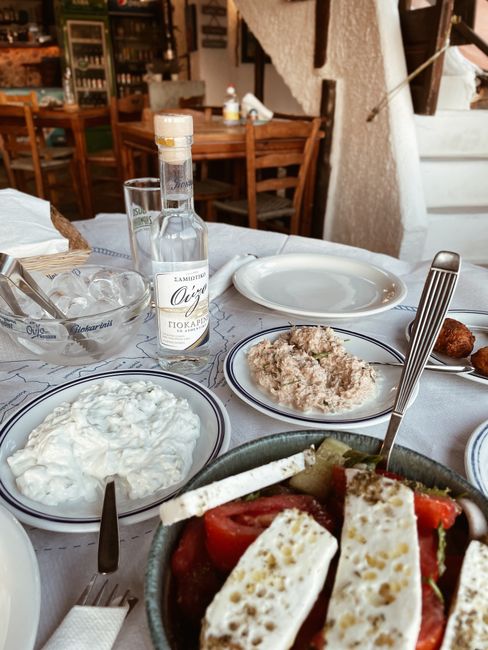
Ouzo and Greek Wine
Ouzo, an anise-flavoured spirit, turns milky white when water or ice is added and is sipped slowly with mezedes. Lesbos is famous for it. Greece also produces distinctive wines from native grapes, such as Assyrtiko from Santorini, Agiorgitiko from Nemea and Xinomavro from Naoussa. A glass of ouzo costs about €3–5, and a glass of wine €4–8.
History
Minoans, Mycenaeans and the Bronze Age
The first great civilisation in the Aegean was the Minoan culture on Crete, which flourished from about 3000 to 1450 BC. The Minoans built large palace complexes, such as Knossos, with colourful frescoes, running water and storerooms for olive oil and wine, and traded across the eastern Mediterranean.
The eruption of Thera
Around 1600 BC, a huge volcanic eruption on Thera, today's Santorini, buried the town of Akrotiri under ash, preserving houses and frescoes that can be visited today.
The Mycenaean world
- From about 1600 BC, the Mycenaeans dominated mainland Greece from fortified palaces such as Mycenae, Tiryns and Pylos.
- They wrote in Linear B, the earliest known form of Greek.
- Their world inspired the legends of the Trojan War told by Homer.
Around 1200 BC, the Mycenaean palaces collapsed, and Greece entered a period known as the Dark Ages, when writing disappeared for several centuries.
Walk through the Lion Gate at Mycenae and visit the Palace of Knossos near Heraklion to see Europe's oldest palace civilisations.
Climate & Best Time to Visit
Spring
8–25°C
March to May brings mild 15–25°C days, wildflowers on the hills and green landscapes, ideal for sightseeing at archaeolo…
Summer
21–35°C
June to August is hot, dry and sunny, with 30–35°C days and heatwaves above 40°C, especially in Athens. The meltemi wind…
Autumn
12–28°C
September and October are warm, with 22–28°C days and the sea at its warmest, making them excellent months for beaches a…
Winter
4–15°C
December to February is mild and wet, with 10–15°C days in Athens and the islands and snow in the mountains, where ski r…
Fascinating Fun Facts
Thousands of islands
Greece has about 6,000 islands and islets in the Aegean and Ionian seas, but only about 200 are inhabited. The largest i…
The original Olympic Games
The ancient Olympic Games were held at Olympia, in the western Peloponnese, every four years from 776 BC, according to t…
One of the oldest languages in Europe
Greek has been spoken and written for about 3,400 years, from Linear B tablets of the Mycenaean period to today, making …
A land of olive oil
Greece is one of the world's largest producers of olive oil, and Greeks consume about 12 litres per person each year, am…
Sunshine almost every day
Greece receives about 250 days of sunshine a year, and Athens has more than 2,800 hours of sunshine annually, one of the…
Name days matter more than birthdays
Many Greeks celebrate their name day, the feast day of the saint they are named after, more than their birthday. On popu…
Traveler Reviews (0 reviews)
Sign in to leave a review and share your experience.
Sign InNo reviews yet. Be the first to share your experience!