New York
Updated October 19, 2026
Also known as: New York City, NYC, The Big Apple
Main Landmarks in New York

Central Park
Central Park is the 341-hectare green space running 4 km through the middle of Manhattan, designed by Frederick Law Olmsted and Calvert Vaux and opened in 1858. Highlights include Bethesda Terrace and Fountain, Bow Bridge, the Strawberry Fields memorial to John Lennon and the Jacqueline Kennedy Onassis Reservoir, circled by a 2.5 km running track. Rent a rowing boat at the Loeb Boathouse in summer, or a bike for about $15–20 per hour. Entry is free. Cars are banned on park drives, so walk or cycle without traffic. Visit early in the morning, when runners, dog walkers and birdsong replace the crowds.

Statue of Liberty and Ellis Island
The Statue of Liberty, dedicated in 1886 and a UNESCO World Heritage Site since 1984, stands 93 m from ground to torch on Liberty Island in New York Harbor. One ferry ticket from Battery Park with Statue City Cruises, from about $25, covers Liberty Island and Ellis Island, where the National Museum of Immigration tells the story of 12 million arrivals. Pedestal and crown access require separate reservations, and crown tickets sell out months ahead. Security checks are airport-style, so allow extra time. Take the first ferry of the morning to avoid queues, and set aside four to five hours for both islands.

Empire State Building
The Empire State Building is the 443 m Art Deco skyscraper completed in 1931 in only 410 days, and the most famous building on the New York skyline. Its open-air 86th-floor observatory gives 360-degree views over Manhattan, the rivers and Central Park, while the 102nd-floor deck adds floor-to-ceiling windows. A museum on the 2nd floor covers its construction and appearances in films such as King Kong. Tickets start at about $44, with extra charges for the top deck and sunrise visits. Go late in the evening, after 22:00, when queues shorten and the city lights spread below.
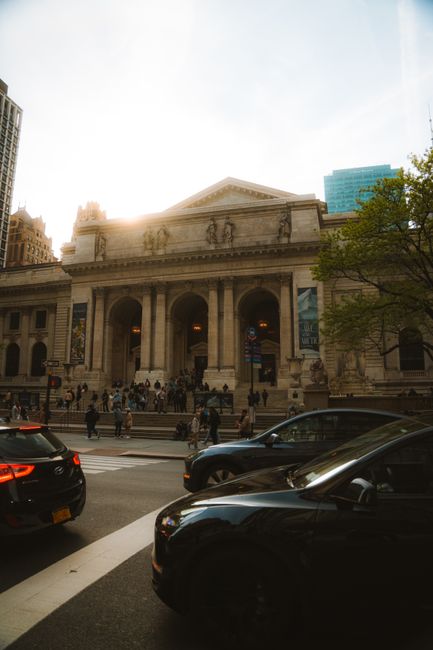
The Metropolitan Museum of Art
The Metropolitan Museum of Art, founded in 1870 on Fifth Avenue at the edge of Central Park, is the largest art museum in the United States, with about 1.5 million works spanning 5,000 years. Highlights include the Temple of Dendur from ancient Egypt, Washington Crossing the Delaware by Emanuel Leutze, Vermeer paintings and a full collection of medieval armour. The rooftop garden, open from spring to autumn, offers drinks with views over the park. Admission costs $30 for visitors from outside New York State. Plan at least three hours, and come on Friday or Saturday evening, when it stays open until 21:00.

Brooklyn Bridge
The Brooklyn Bridge, opened in 1883, was the first steel-wire suspension bridge and, at the time, the longest suspension bridge in the world, with a main span of 486 m. Its Gothic granite towers and web of cables link Lower Manhattan with Brooklyn across the East River. The elevated wooden promenade lets pedestrians cross for free in about 30 minutes. On the Brooklyn side, the DUMBO neighbourhood frames the Manhattan Bridge between brick warehouses, and Brooklyn Bridge Park offers views of the skyline. Walk from Brooklyn toward Manhattan at sunrise or late evening, when crowds are thinner and the skyline faces you.

Times Square
Times Square is the intersection of Broadway and Seventh Avenue in Midtown Manhattan, famous for its walls of giant LED billboards and about 330,000 people passing through on a busy day. It took its name from The New York Times, which moved here in 1904, and has hosted the New Year's Eve ball drop since 1907. The surrounding Theater District holds most of the 41 Broadway theatres. The TKTS booth under the red steps sells same-day show tickets at up to 50% off. Restaurants on the square are expensive and average, so eat in nearby Hell's Kitchen instead. Visit after dark for the full effect of the lights.

The High Line
The High Line is a 2.3 km elevated park built on a disused freight rail line on Manhattan's West Side, opened in stages from 2009. Planted with wild grasses and perennials, it runs from Gansevoort Street in the Meatpacking District to Hudson Yards, passing art installations and views of the Hudson River. It inspired similar elevated parks around the world. Entry is free, and it opens daily from 07:00. At the southern end stands the Whitney Museum of American Art, and Chelsea Market sits nearby for lunch. Walk it on a weekday morning, as weekend afternoons are crowded.

9/11 Memorial and Museum
The National September 11 Memorial and Museum stands on the site of the World Trade Center towers destroyed on 11 September 2001. Two reflecting pools, each about 4,000 m², sit in the footprints of the Twin Towers, with the names of 2,983 victims cut into the bronze panels around them. The memorial plaza is free, while the underground museum costs about $36 and holds the Survivors' Stairs and twisted steel from the towers. Allow two hours for the museum. Nearby, One World Trade Center rises 541 m, and its One World Observatory occupies floors 100–102. Visit quietly and respectfully.
History
New York began as New Amsterdam, a Dutch trading post founded on the southern tip of Manhattan in 1624–1625 to ship beaver furs to Europe. In 1626 the colony's director, Peter Minuit, is said to have bought the island from the Lenape people for goods worth 60 guilders. The English seized the town in 1664 and renamed it after the Duke of York. After independence, New York briefly served as the first capital of the United States, and George Washington took his oath of office on Wall Street in 1789. The Erie Canal, opened in 1825, linked the port with the Great Lakes and made the city the country's commercial leader. Between 1892 and 1954 about 12 million immigrants passed through Ellis Island, and many stayed in tenements on the Lower East Side. In 1898 Manhattan, Brooklyn, Queens, the Bronx and Staten Island merged into Greater New York. The 20th century brought skyscrapers, the subway in 1904, Broadway, jazz in Harlem and Wall Street finance. The attacks of 11 September 2001 destroyed the World Trade Center, and the rebuilt One World Trade Center opened in 2014. Today about 8.5 million people live in the city.
Culture
New York is a city of neighbourhoods, each with its own character: Italian bakeries in Arthur Avenue in the Bronx, Chinese markets in Flushing, Dominican music in Washington Heights and Hasidic communities in Williamsburg. More than 800 languages are spoken across the five boroughs, which makes it one of the most linguistically varied cities on Earth. Culture runs on a huge scale: about 40 Broadway theatres, the Metropolitan Opera, Carnegie Hall and museums such as the Met, MoMA and the Guggenheim. Jazz clubs in Greenwich Village and Harlem play every night, and hip-hop was born at a party in the Bronx in 1973. New Yorkers walk fast, speak directly and value their time, but they readily give directions. Food is a daily obsession, from $1.50 slices to tasting menus. The calendar is packed with the Thanksgiving Day Parade, the New Year's Eve ball drop in Times Square and the New York City Marathon in November.
Climate
Spring
4–22°C
March to May warms from 10°C to 22°C, with cherry blossoms in Central Park and the Brooklyn Botanic Garden in April. It …
Summer
19–30°C
June to August is hot and humid, with 27–32°C afternoons and heatwaves above 35°C. Subway platforms feel like ovens, but…
Autumn
7–24°C
September to November is often the most pleasant season, with dry, sunny days of 15–24°C and golden leaves in Central Pa…
Winter
-3–6°C
December to February is cold, with 0–6°C days, icy winds between skyscrapers and occasional snowstorms. December is fest…
Fun Facts
The subway never sleeps
New York's subway, opened in 1904, runs 24 hours a day, every day of the year, which is rare among big-city metros. With…
Central Park is bigger than Monaco
Central Park covers 341 hectares, larger than the entire principality of Monaco at about 208 hectares. It looks natural,…
The Empire State Building has its own ZIP code
The Empire State Building is so large that it has its own postal code, 10118. Completed in 1931 in just 410 days, it was…
Hundreds of languages in one city
Researchers at the Endangered Language Alliance have mapped more than 800 languages spoken in the New York metropolitan …
A whisper crosses Grand Central Terminal
Outside the Oyster Bar on the lower level of Grand Central Terminal, a low tiled arch carries sound in a surprising way.…
Manhattan was bought for 60 guilders
According to a 1626 Dutch letter, Peter Minuit bought Manhattan from the Lenape for trade goods worth 60 guilders, a sum…
Local Cuisine in New York

New York-style pizza
A thin, wide slice with a crisp base, chewy edge, tangy tomato sauce and melted mozzarella, folded in half and eaten on the street. The style began with Italian immigrants, and Lombardi's in Little Italy opened as a licensed pizzeria in 1905. Classic slices cost $3–5, while famous pizzerias such as Joe's and Di Fara are worth the queue.

Bagel with lox
A boiled and baked bagel, chewy inside and glossy outside, spread with cream cheese and topped with thin slices of cured salmon, capers and red onion. Eastern European Jewish immigrants brought bagels to the Lower East Side in the late 19th century. Russ & Daughters, open since 1914, is a classic stop. Expect to pay $12–20.

Pastrami on rye
A towering sandwich of hot, peppery smoked beef brisket, sliced thick and piled on rye bread with spicy brown mustard. It is the signature of New York's Jewish delicatessens, and Katz's Delicatessen, open since 1888 on the Lower East Side, is the most famous. A sandwich costs about $28–30 but easily feeds two, served with pickles.

New York cheesecake
A dense, rich and creamy cake made with cream cheese on a graham cracker base, heavier and smoother than European versions. The New York style became famous in the 20th century through restaurants such as Junior's in Brooklyn, open since 1950. Eat it plain or with strawberry topping. A slice costs about $8–12.
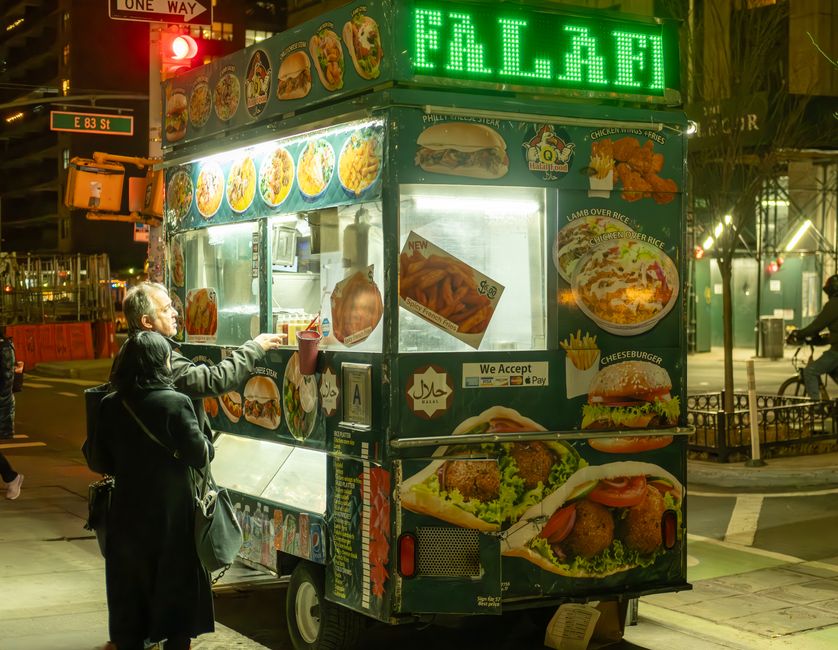
Halal cart chicken over rice
Spiced grilled chicken over yellow rice with lettuce, white sauce and fiery red hot sauce, served from street carts across Midtown. The style was made famous by The Halal Guys, which started as a hot dog cart on 53rd Street and Sixth Avenue in 1990. A generous platter costs $10–13 and is a classic late-night meal for New Yorkers.

Hot dog
A grilled or boiled all-beef frankfurter in a soft bun with mustard, sauerkraut or onions in red sauce, sold from street carts and old-school stands. Nathan's Famous at Coney Island has served hot dogs since 1916 and hosts a hot dog eating contest every 4 July. Street-cart hot dogs cost about $3–5, an easy snack between sights.
Practical Travel Information
Transport & Accessibility
International Transport
New York has three major airports. John F. Kennedy International (JFK), in Queens, handles most long-haul flights; LaGuardia (LGA), also in Queens, serves mainly domestic routes; and Newark Liberty International (EWR) lies across the Hudson River in New Jersey. From Newark, NJ Transit trains reach Penn Station in about 30 minutes for around $16 including the AirTrain. Amtrak trains from Penn Station and Moynihan Train Hall link the city with Boston, Philadelphia and Washington, D.C., while long-distance buses leave from the Port Authority Bus Terminal. Cruise ships dock at piers in Manhattan and Brooklyn.
Local Transport
The subway is the fastest way around, running 24 hours on 472 stations. A ride costs $3, paid by tapping a contactless bank card or phone at OMNY readers, and fares cap at $35 for seven days after 12 paid rides on the same card. Buses use the same system. Yellow taxis and ride-hailing apps are widely available but slow in traffic, and a congestion charge applies to vehicles entering Manhattan below 60th Street. Citi Bike offers bike-share docks across the city. The free Staten Island Ferry and the NYC Ferry, about $4.50, offer cheap river views. Walking is often the best option in Manhattan.
Safety & Health
Personal Safety
New York is safer than its old reputation suggests, and the main tourist areas are busy and well policed. Watch for pickpockets in crowded places such as Times Square, the subway and Rockefeller Center at Christmas. Ignore people selling CDs or offering free items that are followed by demands for money, and avoid costumed characters who charge for photos. On the subway late at night, ride in the conductor's car near the middle of the train. Some areas of the outer boroughs can feel unsafe after dark, so use main streets. In an emergency, call 911.
Medical Services
New York has excellent hospitals, including NewYork-Presbyterian, Mount Sinai and NYU Langone, all with 24-hour emergency departments. Medical care is very expensive for visitors without insurance, so buy travel insurance with strong medical cover. For minor issues, walk-in urgent care clinics such as CityMD charge about $150–250 without insurance. Pharmacies like CVS, Walgreens and Duane Reade are on almost every block, and some are open 24 hours. Tap water is safe and of high quality, coming from protected reservoirs in upstate New York. Bring sunscreen in summer and warm layers in winter.
Budget & Costs
Travel Costs
New York is one of the most expensive cities in the world. A hostel bed costs $60–100, a mid-range hotel $250–400 and a luxury hotel $600 or more, plus hotel taxes of about 14.75% and a nightly fee of about $3.50. A slice of pizza costs $3–5, a deli sandwich $15–20, a casual dinner $30–50 per person and a cocktail $18–25. A subway ride costs $3. The Empire State Building starts at about $44, the Met at $30 and Broadway shows at $80–300. A mid-range traveller should budget $350–500 per day, including accommodation.
Budget Tips
Use the many free attractions, including Central Park, the High Line, the Staten Island Ferry for views of the Statue of Liberty, the Brooklyn Bridge and the 9/11 Memorial plaza. Some museums offer free or pay-what-you-wish hours, and the Bronx Museum of the Arts is always free. Eat at food halls, delis and halal carts instead of sit-down restaurants. Stay in Long Island City, Brooklyn or Jersey City for cheaper hotels near the subway. Use the OMNY weekly fare cap and walk where possible.
Culture & Traditions
Social Norms
New Yorkers are direct and busy, but helpful. Walk briskly on the right side of the sidewalk, never stop suddenly in the middle, and step aside to check your phone. On escalators, stand on the right. On the subway, let people exit before boarding, move into the car and take off your backpack. Tipping is expected in restaurants, bars and taxis. Queues are respected, so never cut in line. Do not block bike lanes. Conversation with strangers is common in delis and parks, and small talk about the weather or sports is welcome.
Cultural Activities
See a Broadway or off-Broadway show, and catch jazz at the Village Vanguard or a gospel service in Harlem on Sunday morning. Watch a Yankees or Mets baseball game in summer, or the Knicks at Madison Square Garden in winter. Join the New York City Marathon crowds in November or the Macy's Thanksgiving Day Parade. Visit the Museum of Modern Art, the Guggenheim and the Whitney. Explore street art in Bushwick, ethnic food in Jackson Heights and the Smorgasburg food market in Brooklyn on summer weekends.
Unique Experiences in New York
Attend a Sunday gospel service at a Harlem church such as Abyssinian Baptist Church, founded in 1808, and hear one of the city's great choirs. Dress respectfully, arrive early as space for visitors is limited, and remember that it is a worship service, not a show.
Eat your way through Jackson Heights in Queens, where Indian, Nepali, Tibetan, Colombian and Ecuadorian food stalls line Roosevelt Avenue under the elevated 7 train. A food crawl of momos, arepas and samosas costs $25–40 per person and shows a side of the city most tourists miss.
Kayak on the Hudson River for free with the Downtown Boathouse, which offers walk-in sessions from piers in Lower Manhattan on summer weekends. Paddle for 20 minutes with views of the skyline and the Statue of Liberty in the distance.
Ride the free Staten Island Ferry at sunset for a 25-minute crossing past the Statue of Liberty and the Lower Manhattan skyline. The orange ferries run 24 hours a day, every 15–30 minutes, and you can return on the next departure without leaving the terminal.
Win cheap Broadway tickets through digital lotteries on apps such as TodayTix or Broadway Direct, where seats for hit shows cost $30–50. Enter the day before or the morning of the show, or queue at the TKTS booth in Times Square for same-day discounts of up to 50%.
Travel Recommendations for New York
Explore beyond Manhattan. Take the subway to Brooklyn for DUMBO, Williamsburg and Prospect Park, to Queens for Astoria's…
Wear comfortable shoes and plan your days by area to save time. New Yorkers often walk 15–20 km a day, and subway statio…
Check the free events calendar before you arrive. In summer, Shakespeare in the Park, SummerStage concerts, Bryant Park …
Stay near a subway line rather than in central Midtown to save money. Neighbourhoods such as Long Island City in Queens,…
Book timed tickets online for the Statue of Liberty, the Empire State Building, the 9/11 Museum and observation decks su…